
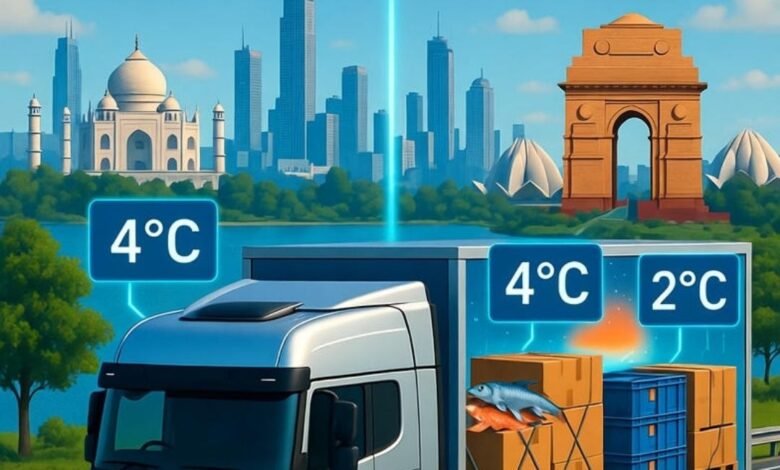
India loses ₹1.38 lakh crore worth of perishable goods every year due to inadequate cold chain infrastructure. In a country where summer temperatures routinely cross 45°C, maintaining an unbroken temperature-controlled supply chain is not a luxury; it is survival. This is why cold chain logistics services in Mumbai and cold chain transportation services in Delhi have become two of the most critical services for pharmaceuticals, dairy, seafood, vaccines, and fresh produce in 2025.
Why India’s Cold Chain Matters More Than Ever in 2025
- Market size: ₹2.6 lakh crore (growing 15–18% annually)
- Installed cold storage: 43 million MT (still 18 MT short)
- Reefer vehicles on road: ~1,30,000 and rising fast
- 74% of new drug launches in India are temperature-sensitive
- Quick-commerce platforms deliver ice cream in 10 minutes – only possible because of hyper-local cold chain
Mumbai and Delhi-NCR together account for nearly 40% of India’s organised cold chain capacity and handle the most complex, high-value shipments in the country.
Cold Chain Logistics Services in Mumbai – The Export & Seafood Capital
Mumbai is India’s cold chain crown jewel for three reasons:
- Unmatched Connectivity – 2–3 hour transfer time from any factory to Mumbai International Airport pharma cargo terminal – JNPT Port handles 58% of India’s reefer container exports
- Specialised Infrastructure – Over 2.3 million pallets of multi-compartment GDP warehousing – Largest cluster of -80°C and cryogenic (-196°C) facilities in Asia – Dedicated active container (Envirotainer, CSafe, va-Q-tec) stations inside the airport
- Expertise in High-Value Shipments Companies routinely move ₹500+ crore oncology drugs and cell therapies from Mumbai to the US and Europe with zero temperature excursions.
Top providers in Bhiwandi, Navi Mumbai, and Taloja now offer “airport-in-airport-out” services where the product never leaves a validated cold zone – not even during customs inspection.




Cold Chain Transportation Services in Delhi – The Heart of North India
Delhi-NCR is where consumption meets redistribution.
Key advantages of cold chain transportation services in Delhi:
- Serves 500+ million consumers within a 12-hour radius
- Highest density of 1-ton to 10-ton reefers for last-mile and q-commerce
- Six major GDP hubs within 60–90 minutes of IGI Airport
- Electric & CNG reefer fleets mandatory under GRAP-IV pollution rules
- Direct refrigerated rail links to Northeast, South, and West India
From delivering Amul milk at 4°C to Noida homes at 6 AM to moving Covishield vaccines to Uttarakhand in -25°C containers, Delhi’s cold chain runs 24×7×365.
Technology That Makes Zero Excursions Possible in 2025
| Technology | Real-World Impact |
|---|---|
| 5G + IoT sensors | Data upload every 30–60 seconds |
| Blockchain temperature ledger | Accepted by USFDA, EMA & CDSCO |
| AI predictive route analytics | Warns of excursion risk 6 hours early |
| Phase Change Material (PCM) | Maintains temperature for 168+ hours without power |
| Electric reefers | Zero emission last-mile in Delhi |
| Drone emergency delivery | Medicines reach remote areas in <45 minutes |
Sector-Wise Temperature Requirements
| Sector | Temperature Range | Primary Hub |
|---|---|---|
| Vaccines & Biologics | -80°C to +8°C | Mumbai + Delhi Airports |
| Insulin | +2°C to +8°C (no freeze) | Pan-India last-mile |
| Ice Cream | -22°C to -25°C | Mumbai → Delhi → Tier-2 |
| Shrimp & Seafood | -18°C glazed | Mumbai ports |
| Flowers | +1°C to +5°C | Delhi Airport exports |
| Chocolates | +15°C to +18°C | Quick-commerce dark stores |
How to Choose the Right Partner in 2025
Must-have credentials:
- WHO GDP & IATA CEIV Pharma certification
- 99.99% temperature compliance guarantee
- 24×7 control tower with direct escalation to senior management
- Calibrated sensors (±0.1°C accuracy) with annual third-party validation
- Insurance covering declared value + consequential loss
- Separate pharma handling team (no cross-contamination with ice cream)
Latest Cost Benchmarks (November 2025)
| Service | Approx Rate (₹) |
|---|---|
| Mumbai → Delhi 32-ton +2 to +8°C FTL | 2.05 – 2.55 lakh |
| Mumbai local distribution (per kg) | 24 – 42 |
| Delhi-NCR last-mile active van (per drop) | 480 – 1,100 |
| -80°C cryogenic airport transfer Mumbai | 35,000 – 75,000 per box |
- Why 2025 is a Turning Point for India’s Cold Chain Industry 2025 mein India ka cold chain sector 15–18% CAGR se badh raha hai kyunki 74% nayi medicines temperature-sensitive hain aur quick-commerce ne 10-minute ice-cream delivery ko normal bana diya hai. Government ne ₹12,000 crore ka new subsidy scheme launch kiya hai aur 2026 se har reefer truck mein mandatory real-time tracking hoga. Is saal 22,000 naye reefer vehicles road par aayenge aur 8 million MT fresh cold storage capacity add hogi. Yeh saal cold chain ke liye “make-or-break” hai – jo companies ab GDP-certified partners ke saath tie-up kar lenge, woh next 10 saal dominate karenge.
- Mumbai vs Delhi: Which City Should You Choose for Cold Chain? Agar aap export karte ho (pharma, seafood, flowers) toh Mumbai best hai – airport 2.5 ghante ke andar, JNPT port, -80°C infrastructure sabse zyada. Agar aap North India distribution, dairy, fruits ya quick-commerce ke liye kaam karte ho toh Delhi-NCR unbeatable hai – 500 million consumers 12 ghante ke radius mein aur sabse zyada small reefer vehicles. Short answer: Export → Mumbai, Consumption → Delhi.
- Top 7 Locations in Mumbai for GDP-Certified Cold Storage (2025)
- Bhiwandi (60% capacity)
- Taloja MIDC
- Panvel & Navi Mumbai
- Vasai-Virar
- Kalamboli
- Turbhe
- Andheri-Saki Naka (airport proximity) In sab zones mein 24×7 power backup, -80°C freezers aur direct airport connectivity hai.
- Best Cold Chain Hubs in Delhi-NCR You Must Know About
- Manesar – Gurugram (largest pharma hub)
- Sonipat – Kundli (dairy & fruits)
- Greater Noida & Dadri (export flowers)
- Alipur & Narela (quick-commerce dark stores)
- Rai Industrial Area (electric reefer parking) Yeh 5 hubs 85% Delhi-NCR cold chain capacity control karte hain.
Conclusion
As India marches toward a $5 trillion economy and emerges as the pharmacy of the world, the cold chain has quietly become one of its most valuable strategic assets. Every vaccine dose that reaches a child in Ladakh, every insulin vial delivered to a diabetic patient in Delhi at 4 AM, and every ₹500 crore oncology shipment that leaves Mumbai airport without a single degree of deviation depends on the silent precision of cold chain logistics services in Mumbai and cold chain transportation services in Delhi.
In 2025, the technology is ready, the infrastructure is expanding at record speed, and the expertise now matches global benchmarks. What remains is the decision: will you treat temperature-controlled logistics as a cost centre or as the ultimate insurance policy for your product quality, regulatory compliance, customer trust, and brand reputation?
Frequently Asked Questions (FAQs)
What happens if temperature deviates during transit? Immediate alert → diversion to nearest validated facility → root-cause analysis → full compensation (declared value + 10× freight + testing/recall costs if applicable).
What services are included in cold chain logistics services in Mumbai? End-to-end temperature-controlled warehousing, validated packaging, reefer transport, real-time monitoring, customs brokerage for pharma, and airport handling – all under strict GDP guidelines.
Can I get same-day cold chain transportation services in Delhi? Yes. Most providers offer same-day booking for 1–10 ton reefers if requested before 11 AM. Life-saving drugs get priority slots and dedicated lanes.
How is temperature tracked from Mumbai to Delhi? Calibrated IoT loggers record data every 1–5 minutes. Live data is visible on web/app dashboards and stored on blockchain for regulatory acceptance.
Are cold chain services available 24×7, including Sundays and holidays? Yes. All major players operate round the clock, including airport transfers on 26th January and 15th August – critical for clinical trials and emergencies.